
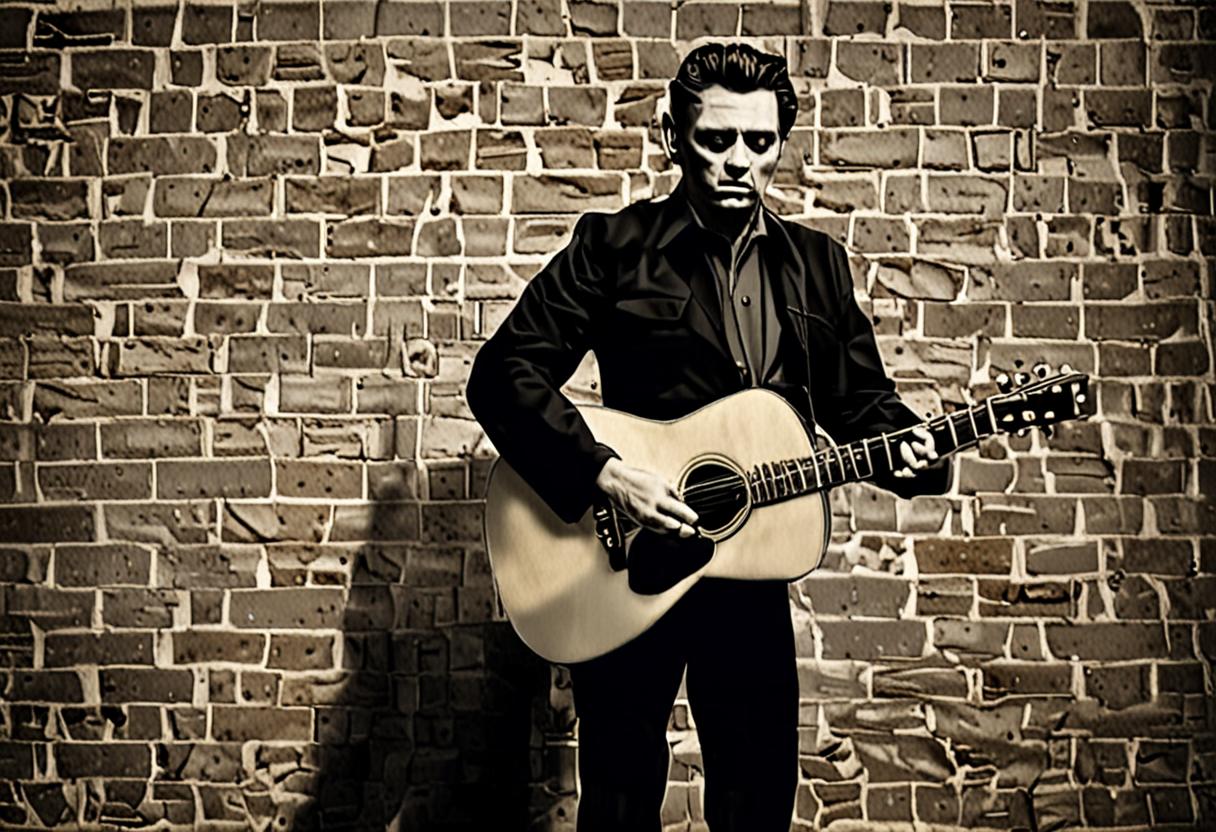
When Johnny Cash released “Folsom Prison Blues” in 1955, he wasn’t just putting out another country single: he was defining a persona, a mythology, and a cultural fault line that American music still hasn’t stopped shaking from. Before the Man in Black became The Man in Black, before he became the patron saint of misfits, convicts, working men, and anyone who’d ever felt caged inside their own life, there was this song — stark, unvarnished, and unsettlingly honest.
Cash was still a young Air Force veteran then, an outsider who didn’t belong anywhere except maybe inside the stories he wrote. Folsom Prison Blues came from that space: a place where empathy met darkness, where a simple melody could feel like the echo of a whole country trying to forgive itself.
A Shot Fired in American Music
“Folsom Prison Blues” is remembered for its opening line as much as for its sound. I shot a man in Reno just to watch him die wasn’t bravado. It wasn’t shock value. It was Cash telling the truth about the human psyche — the unheroic, the unpretty, the unspoken. And this honesty rattled people.
Country music at the time was polished, safe, and built for radio. Cash arrived with a voice that sounded like a train engine and a guitar line that felt like someone pacing in a cell — minimal, hard, unadorned. He didn’t imitate the country establishment. He stared it down.
And listeners immediately recognized something: authenticity.
Not the curated authenticity of the 2020s, but something raw, flawed, and frighteningly direct.
A Song That Made Its Own World
Cash hadn’t yet played a prison when he wrote the song, but he understood confinement — emotional, existential, and social — better than most people who ever would. The genius of “Folsom Prison Blues” is that it doesn’t lecture. It inhabits. It becomes the prisoner’s voice without romanticizing him.
That empathy is why convicts embraced Cash decades before the rest of America canonized him. He didn’t pity them. He didn’t judge them. He simply said: I hear you. I know you.
And for men who had been erased by society, that was liberation.
Legacy: More Than a Hit, a Blueprint
When Cash finally recorded At Folsom Prison in 1968, the song came home — roaring, triumphant, and dangerous. The live version became definitive, proof that Cash wasn’t performing a persona; he was living in the skin of the people he sang about.
“Folsom Prison Blues” became the anthem of outlaw country before the genre even had a name. It inspired Merle Haggard while he was still an inmate. It influenced rock rebels, punk bands, grunge survivors. It paved the way for artists who wrote from the margins instead of the center.
Its DNA is everywhere: in Springsteen’s dust-covered narrators, in Steve Earle’s rawness, in Sturgill Simpson’s defiant modernism, in the darker corners of Americana and alternative country.
Cash didn’t write a single.
He wrote a worldview.
Why It Endures
Because we still live in a world of prisons — physical, emotional, digital, societal. Because the gap between freedom and confinement remains narrow and fragile. Because Cash voiced a truth that society tries to hide: that good people can make terrible decisions, and terrible people can carry goodness inside them.
And because sometimes, one voice and one guitar are enough to shake the moral foundation of a country.
“Folsom Prison Blues” isn’t nostalgia.
It’s not a relic.
It’s a mirror.
And Johnny Cash, even in 1955, wasn’t offering comfort.
He was offering clarity.