
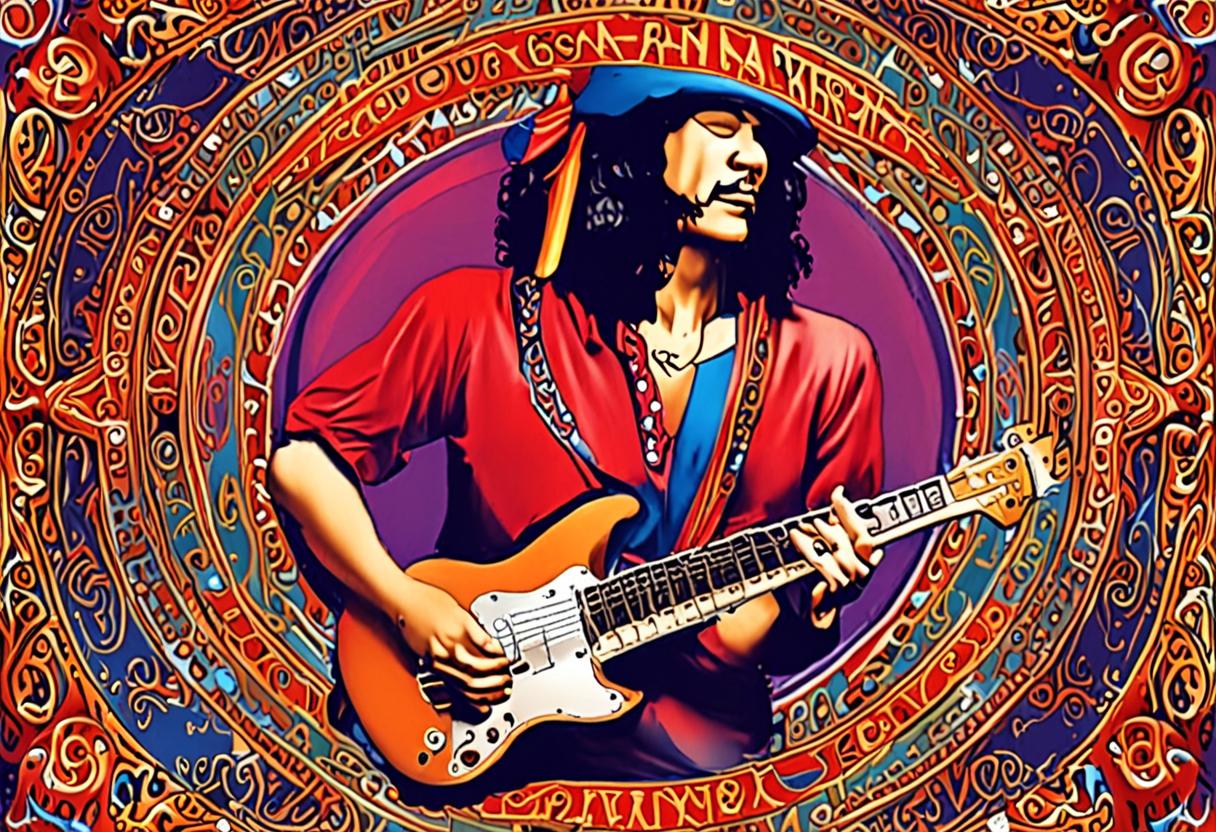
When “Smooth” reached No. 1 on the Billboard Hot 100 in late 1999, the achievement felt almost surreal.
Carlos Santana, a guitarist whose prime was supposedly decades behind him, suddenly stood at the epicenter of global pop culture again — not as a nostalgic revival act, but as a dominant presence reshaping the sound of a new millennium.
With Smooth, Santana didn’t just return.
He detonated.
The track, featuring Rob Thomas of Matchbox Twenty, became a generational phenomenon — a multi-format, multi-demographic juggernaut that remained at No. 1 for 12 weeks and helped Supernatural sweep the 2000 Grammys, tying Michael Jackson’s record.
But focusing only on the statistics misses the deeper story:
“Smooth” was the perfect collision of eras, cultures, and musical instincts.
A Collaboration That Shouldn’t Have Worked — But Did
Santana, the psychedelic Latin-rock pioneer of Woodstock, and Rob Thomas, an alternative-pop frontman from the ’90s mainstream?
On paper, it looked mismatched.
In reality, it was alchemy.
Thomas brought a sensual, modern pop phrasing; Santana underpinned it with that unmistakable guitar — warm, singing, almost vocal in its phrasing.
The contrast made the track irresistible.
“Smooth” felt familiar and completely new at the same time.
It was Latin rock painted with millennium-era gloss.
The Sound: Sweat, Heat, and Groove
There’s a reason the song instantly conjures heat, rooftops, summer, bodies moving.
The groove is pure physical energy:
a percussive heartbeat rooted in Afro-Latin tradition, wrapped in contemporary production that still sounds fresh today.
Santana’s guitar doesn’t overpower; it breathes through the track.
It bends and slides with a fluidity that feels vocal — never shredding, always speaking.
Each lick is a call-and-response with Thomas, creating a dialogue rather than a soloist’s spotlight.
This interplay — sensual, rhythmic, human — is the soul of “Smooth.”
Why “Smooth” Mattered Culturally
The late ’90s were a crossroads: teen pop, boy bands, nu-metal, hip-hop dominance.
Radio was balkanized.
Genres rarely crossed.
Santana obliterated those walls.
“Smooth” unified rock, pop, Latin, and adult contemporary audiences in a way that hasn’t happened since.
It introduced younger listeners to Santana’s legacy and reintroduced older fans to a reinvigorated artist.
It also paved the way for the Latin-pop explosion of the early 2000s — Ricky Martin, Shakira, Enrique Iglesias, Jennifer Lopez — by proving that Latin rhythm wasn’t a niche, but a global language.
Santana didn’t follow trends.
He invented a new one.
A Career Rebirth That Felt Almost Mythological
Before Supernatural, Santana’s commercial relevance had faded.
He was respected, revered, but largely absent from the mainstream.
“Smooth” changed everything.
The track wasn’t just a hit — it was a resurrection.
It elevated Santana from legacy icon to active chart titan, landing him nine Grammys in one night and redefining what a “career comeback” could look like.
Few artists in history have experienced a return this dramatic, this organic, and this universally embraced.
Legacy: The Song That Refuses to Age
Twenty-six years later, Smooth is still unavoidable — not because it’s overplayed, but because it still works.
It’s the rare hit that didn’t expire with its trend cycle.
Modern playlists, TikTok edits, wedding bands, radio rotations… it’s everywhere.
Not ironically.
Genuinely.
Because great grooves don’t age.
And great melodies don’t leave.
“Smooth” is one of those songs that belongs to everyone, whether you lived through its release or discovered it last week.