
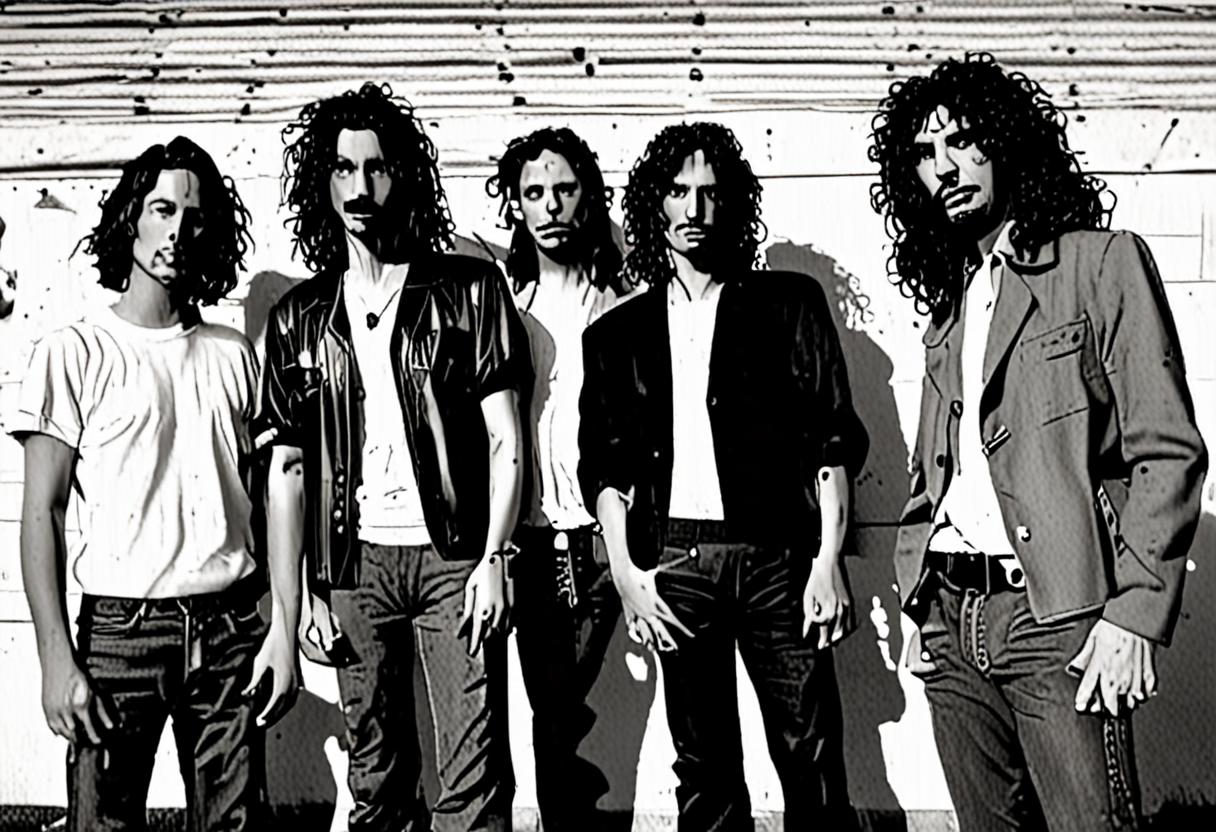
Soundgarden — Louder Than Love (1989)
A Transitional Record That Shows the Teeth of What Was Coming**
When Soundgarden released Louder Than Love in 1989, they weren’t yet “the Soundgarden” that history now frames as one of the pillars of the Seattle movement. This album sits in that crucial space between raw underground identity and the fully-realized artistic force they would become.
And that’s exactly what makes it compelling.
The Sound of a Band Outgrowing Its Cage
Louder Than Love is heavier, darker and far more abrasive than the grunge blueprint that would dominate the early ’90s. There’s a sludgy, metallic edge that links it more closely to early Melvins or Black Sabbath than to the alternative radio sound Seattle would eventually export worldwide.
You can hear a band trying to break out of its own limits — sometimes succeeding, sometimes not.
But even when the record stumbles, it stumbles with intent.
Cornell’s Voice Takes Center Stage
This is one of the first Soundgarden albums where Chris Cornell’s voice becomes the actual architecture of the songs.
He’s not merely singing; he’s pushing, tearing, bending vocal lines into shapes rock hadn’t really heard before.
Tracks like Hands All Over preview the melodic clarity he would later master, while others — Loud Love, Ugly Truth — lean into the borderline-unhinged delivery that gave Soundgarden their early cult identity.
It’s unpolished, yes, but unmistakably his.
Riffs Built Like Concrete Blocks
Kim Thayil’s guitar work is the gravitational center of the album.
The riffs are thick, blunt, and much closer to proto-metal than to the emerging alt-rock vocabulary.
He’s not writing hooks here — he’s constructing monoliths.
It’s music made for density, not accessibility.
And that choice, in retrospect, is what sets Louder Than Love apart from the records that followed.
A Transitional Album — Not Their Best, But Essential
Let’s be honest: Louder Than Love is not Soundgarden’s definitive statement. That honor belongs to Badmotorfinger and Superunknown.
But LTL is the necessary fracture before evolution.
It’s the moment where Soundgarden:
- shed the pure underground skin
- sharpened their sonic identity
- tested their extremes
- found what didn’t work
- and discovered what absolutely did
It’s a document of becoming — and albums of becoming age better than albums built only to impress.
Why It Still Matters
Because without Louder Than Love, the Soundgarden we now consider iconic would not exist.
This was the album where they embraced ambition over comfort, force over polish, experimentation over safety.
It’s a transitional record, yes.
But transitions are where the future is born.