
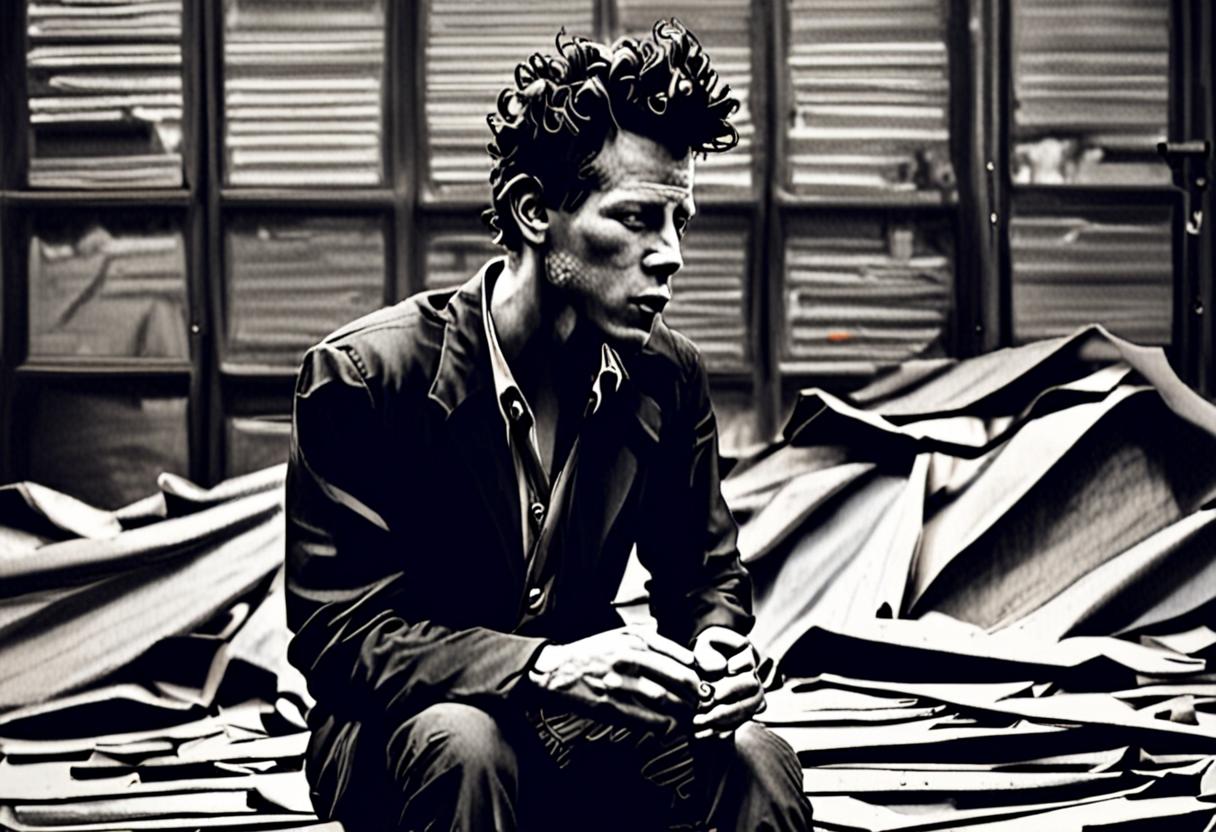
A portrait of the songwriter, the mythmaker, the cinematic spirit who reshaped the sound and soul of American music.
Tom Waits was never merely a singer-songwriter. He arrived in the 1970s like a man stepping out of a late-night screenplay: trenchcoat shoulders, piano-bar gravel in his throat, and an instinctive understanding that storytelling meant inhabiting the shadows other artists ignored. Born on December 7, 1949, Waits has spent half a century proving that music doesn’t need polish to be profound — it needs perspective, mythology, and a willingness to scrape beauty out of ruin.
He is, in essence, America’s last great beat poet who chose a piano instead of a typewriter.
The Early Years — A Drunk Poet at the End of the Bar
In the 1970s, Waits emerged in Los Angeles clubs as if he’d materialized from a noir novel. His early work — Closing Time, The Heart of Saturday Night, Nighthawks at the Diner — belongs to an era of smoke-stained melancholy and late-night confessionals. It’s a world populated by cab drivers, drifters, small-time romantics, and men who fall in love with the sound of their own heartbreak.
Waits didn’t just describe these characters — he became them, slipping into their skins with the ease of an actor.
His voice was already an instrument of fiction, gravelly enough to carry the weight of bad decisions and borrowed dreams.
But his greatest evolution was still ahead.
The Alchemical Shift — Reinvention Through Noise
In the 1980s, after meeting his lifelong creative partner and wife Kathleen Brennan, Waits detonated his earlier aesthetic. Gone were the jazz clubs, gone the saxophone sighs and smoky chords.
In their place:
• clattering percussion
• junkyard orchestration
• distorted carnival soundscapes
• surrealist lyrical fragments
• a voice pushed to the edge of abrasion
Albums like Swordfishtrombones, Rain Dogs, and Bone Machine remain some of the most transformative works in modern music — not because they defied genre, but because they invented a new emotional language. This Waits wasn’t sad or sentimental; he was visionary, theatrical, and apocalyptic.
He turned beauty into something broken, and broke things until they became beautiful.
He taught a generation of musicians that imperfection could be architecture.
Influence — A Fault Line Across Alternative Music
Tom Waits’ influence can be traced like a seismic crack across decades of music.
You hear him in:
- Nick Cave’s sermons and murder ballads
- PJ Harvey’s raw spiritual tension
- Beck’s folk surrealism
- The National’s narrative murmur
- Fiona Apple’s percussive eccentricity
- Eels’ bruised minimalism
- Father John Misty’s meta-melodrama
Even artists who don’t sound like him carry his lesson:
music should not be comfortable — it should be true.
Waits proved that art could be theatrical without losing authenticity, experimental without losing humanity.
The Cinematic Shadow — Tom Waits on Film
Waits is one of the few musicians whose film appearances feel like extensions of his songwriting.
Jim Jarmusch understood this immediately, placing him in Down by Law — a prison-break anti-comedy that matched Waits’ slanted worldview. The chemistry between Waits, John Lurie, and Roberto Benigni remains iconic.
Then came other roles:
- The Fisher King (a broken angel of the apocalypse)
- Bram Stoker’s Dracula (insect-eating Renfield, naturally)
- Short Cuts (the man who holds a city’s guilt in his voice)
- The Imaginarium of Doctor Parnassus (pure spectral mischief)
- The Ballad of Buster Scruggs (the Prospector, practically mythic)
What makes Waits cinematic isn’t acting — it’s presence.
He bends the frame around himself. Directors don’t cast him — they summon him.
The Eternal Outsider — A Career Without Compromise
Waits famously avoids trends, avoids interviews, avoids the machinery of fame.
He has never needed the mainstream; the mainstream, periodically humbled, remembers it needs him.
His catalog is a map of forgotten corners:
empty diners, circus tents at closing time, dreams left on bar stools, ghosts pacing the edges of American folklore.
He is the poet laureate of the unglamorous.
The high priest of the cracked bell.
The man who taught us that art doesn’t shine — it glows in the dark.
Legacy — The Patron Saint of the Beautiful Misfit
Tom Waits’ legacy is not measured in chart positions. It’s measured in:
- the artists he liberated
- the genres he shattered
- the emotional vocabulary he expanded
- the listeners who recognized themselves in the broken glass of his songs
He has lived many artistic lives:
the beat poet, the barfly, the street preacher, the carnival barker, the apocalyptic prophet, the actor-myth.
Yet one truth remains constant:
Tom Waits doesn’t tell stories — he reveals the world beneath the world.
And at 75, his influence feels not historic, but evergreen.