
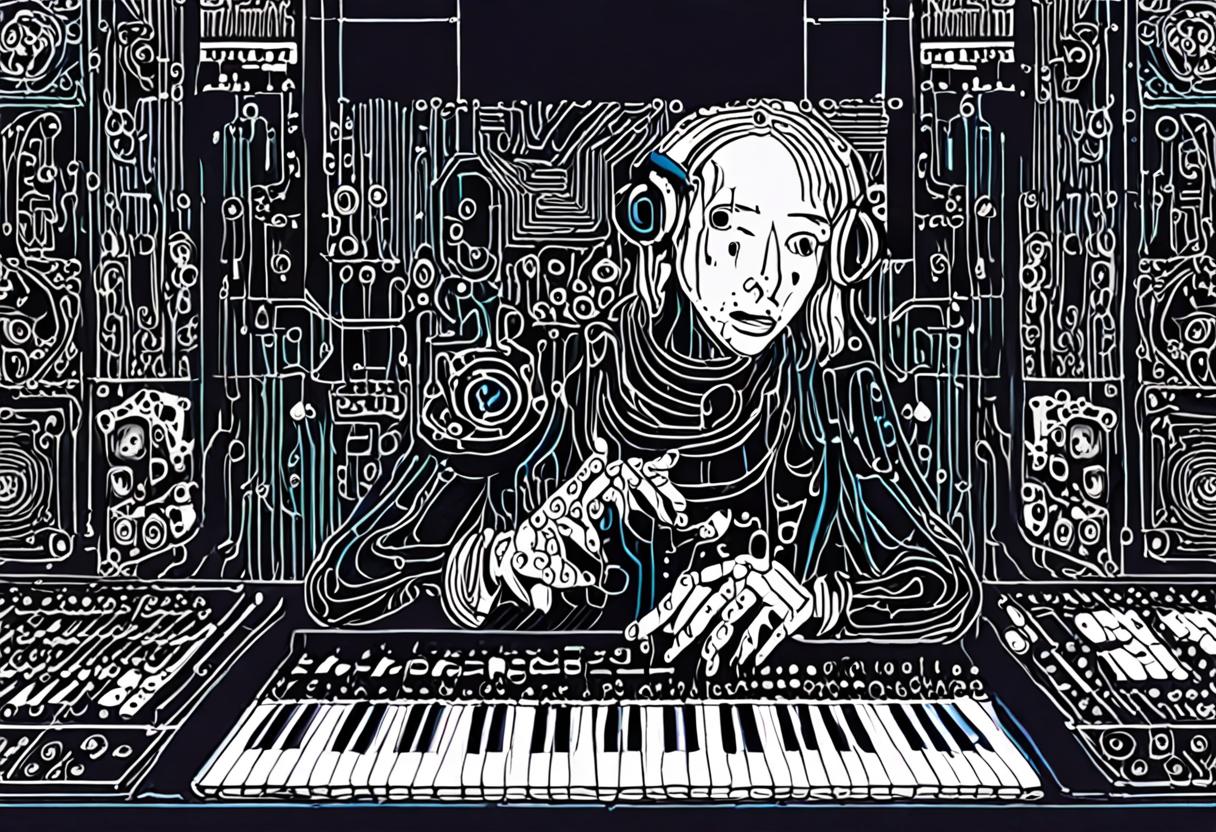
The future of music isn’t arriving — it’s already here, reshaping the industry with a quiet, surgical precision. You can feel it in the speed with which new sounds appear, mutate and vanish. You can see it in the charts, where audience attention has splintered into micro-moments measured in seconds rather than songs. And you can hear it in the increasingly blurred boundary between human and machine creativity.
As 2026 approaches, the music ecosystem is entering what can only be called the algorithmic era: a landscape where artificial intelligence, short-form culture, and real-time metrics aren’t add-ons to the industry — they are the industry.
AI Moves From Experiment to Infrastructure
Not long ago, AI-generated music was a novelty — a technical curiosity or a tool for idea sketches. Today, it sits at the center of strategic licensing deals. Labels are no longer asking whether AI is coming; they’re deciding how to monetize it, regulate it, or quietly adopt it.
Surveys across listener panels show a recurring, disarming truth:
most people can’t reliably distinguish AI-composed tracks from human-made ones.
That fact alone destabilizes the traditional hierarchy. If emotional perception remains intact even when the creator is synthetic, what exactly defines authorship? And more importantly: who owns what?
The conversation is shifting from “AI threatens musicians” to something more complex and uncomfortable:
AI threatens the idea of music as a human-exclusive language.
Short-Form Culture Is Rewriting the Song
The average listener now discovers music in fragments — a hook, a texture, a beat that fits a mood algorithm. Platforms reward immediacy; songs that take too long to reveal themselves are simply invisible.
The unintended consequence is a new kind of composition:
music engineered for the cut, the loop, the 12-second emotional hit.
This doesn’t devalue artistry. It redirects it. Some artists thrive in this pressure cooker: clarity, efficiency, no waste. Others feel trapped in a system where the “moment” matters more than the music surrounding it.
But the reality is stark:
songs are no longer built around verses and choruses — they’re built around shareable atoms.
Discovery Is Now a Data Ecosystem
The old gatekeepers — radio programmers, label reps, festival curators — have ceded influence to a new class of invisible mediators: recommendation algorithms. Their logic is simple but unforgiving:
Serve what keeps the listener on the platform.
It’s an ecosystem optimized for retention rather than depth, which explains why white-noise albums, ambience playlists, and algorithm-friendly pop often outperform meticulously crafted records.
It’s not lack of taste.
It’s momentum physics.
To break through, emerging artists need either an exceptionally distinct signature — or a body of work engineered to accelerate quickly inside the algorithm’s tunnels.
Human Creativity Isn’t Disappearing — It’s Changing Code
Despite the fear, humans are not being replaced. They’re being repositioned. The creative role is moving from “composer of finished works” to “designer of inputs and identities.”
Artists who understand this shift are already shaping the new frontier:
- using AI as a sketchpad, a harmonic partner, a sound-design engine
- releasing music in adaptive formats
- building narratives that survive beyond the first 30 seconds
- treating visual identity as core architecture, not decoration
The musicians who thrive won’t be the ones resisting the algorithmic age, but those who learn to choreograph it.
The Future Is Hybrid — And It’s Already Here
Music is becoming a layered dialogue: human intention at the top, machine possibility underneath. It’s not a battle — it’s a merger.
Listeners don’t care how something was made.
They care how it makes them feel.
That is the leverage point for human artists: emotion, perspective, taste, risk. Machines can simulate patterns; they can’t desire, they can’t fracture, they can’t contradict themselves — all things that define the most compelling art.
The coming decade will be shaped by creators who understand that AI is not a threat to their voice, but an exponential extension of it.
The age of algorithmic creation won’t diminish music. It will demand a new kind of musician — sharper, faster, more intentional.
The ones who embrace the shift won’t merely survive the new era.
They’ll define it.