
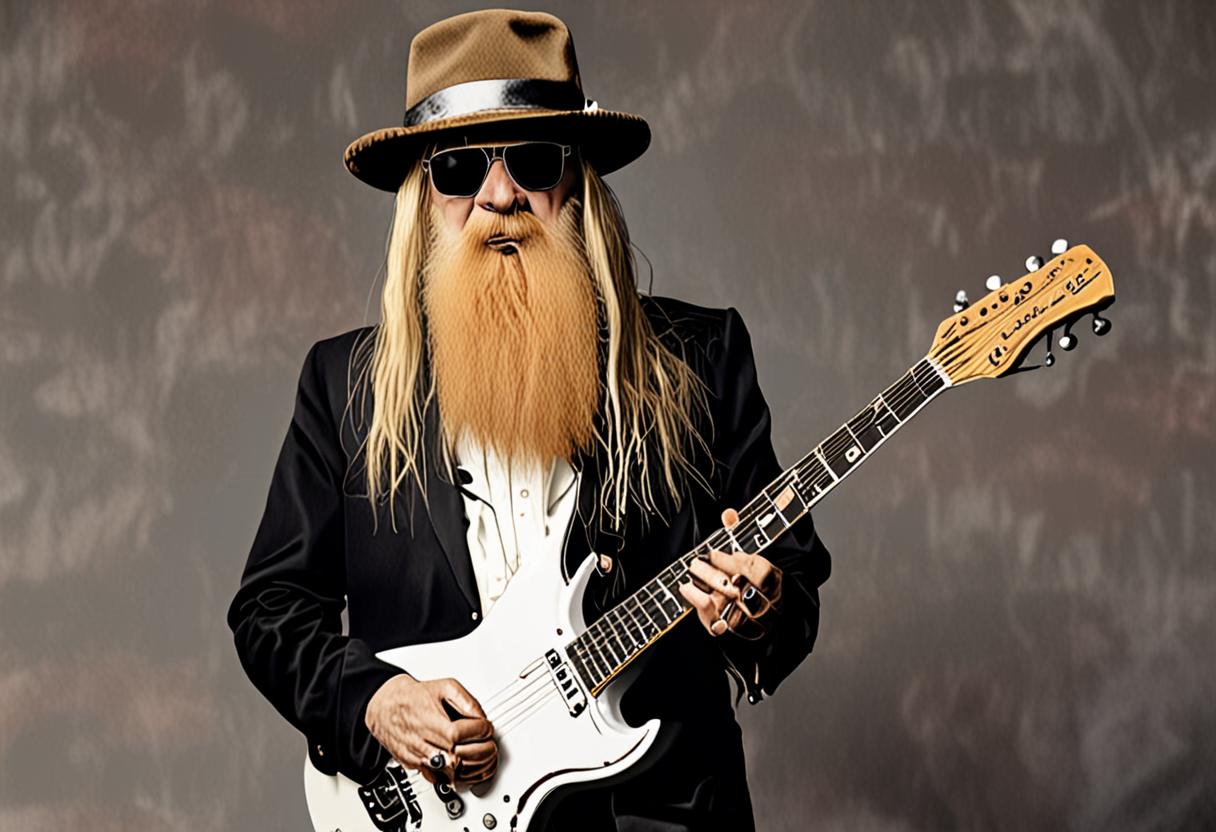
Born December 16, 1949 — Still one of the sharpest tones in American rock
There are guitarists who shred, guitarists who innovate, and guitarists who become myth.
Billy Gibbons, co-founder of ZZ Top, belongs to a rarer category: the players whose tone is so distinctive that three notes are enough to identify them.
Warm, fuzzy, greasy, sharp-edged, swaggering — the “Gibbons sound” is its own ecosystem.
And it didn’t arrive by accident.
From early Houston garages to global stages blazing with neon cacti and spinning furry guitars, Billy Gibbons has built a career on precision minimalism, blues devotion, and a sly theatricality that turned ZZ Top into something both classic and surreal.
The Roots: Texas Blues Reimagined
Before the beards, before the MTV domination, before the platinum records, Gibbons was a blues obsessive.
A disciple of Lightnin’ Hopkins, Muddy Waters, Jimmy Reed.
But he didn’t copy them.
He translated them.
With ZZ Top’s early albums — ZZ Top’s First Album, Rio Grande Mud, Tres Hombres — Gibbons fused Delta blues tropes with:
- Texas boogie heat
- minimalist rhythmic hooks
- distorted textures that felt both dusty and futuristic
He made blues feel dangerous again — not museum-piece reverence, but sweaty, loud, mischievous.
Songs like “La Grange”, “Waitin’ for the Bus/Jesus Just Left Chicago”, and “Beer Drinkers & Hell Raisers” defined that aesthetic: gritty, hypnotic, steeped in groove.
The 1980s Reinvention — A Band That Refused to Age
Unlike many blues-rock bands rooted in the ’60s and ’70s, ZZ Top didn’t get stuck.
They evolved — radically.
In the 1980s, with albums like Eliminator and Afterburner, Gibbons embraced:
- synthesizers
- drum programming
- video-era flamboyance
- chrome-and-leather futurism
This could have been a disaster.
Instead, ZZ Top exploded.
The videos for “Sharp Dressed Man,” “Gimme All Your Lovin’,” “Legs” turned the band into pop culture icons.
Gibbons managed a rare miracle: modernizing the sound without losing the blues soul.
That era made the band immortal.
The Tone: A Fingerprint, Not a Technique
Gibbons is often asked about his gear.
He usually responds with jokes, riddles, or Zen koans.
The truth is simple:
His tone lives in his hands.
He uses ultra-light strings, subtle pick attack, and a touch so controlled it borders on telepathic.
Even at his dirtiest distortion settings, there is clarity — a kind of articulate grit that no one else can fully replicate.
There’s a reason guitarists obsess over his playing:
He makes simplicity sound transcendent.
Longevity Without Compromise
Even as decades roll on, Gibbons remains creatively restless.
Solo albums like Perfectamundo and The Big Bad Blues show a musician who still feels the need to explore rather than rest on legend.
He collaborates, experiments, reinvents — but the voice (both vocal and guitar) remains unmistakably him.
Few artists get to be iconic and playful at the same time.
Billy Gibbons is one of them.
Legacy of a Modern Blues Titan
ZZ Top’s catalog is deceptively influential.
Everyone knows the hits, but musicians know the depth:
- The minimalism that predated indie rock
- The blues revival that didn’t rely on nostalgia
- The ability to fuse humor, style, and musicianship
- The improbable MTV takeover from a Texas boogie trio
Gibbons stands at the center of all of it — a bridge between eras, genres, and textures.
He is, in every sense, a musician’s musician.
And yet he still feels underrated, perhaps because he makes it all look so effortless.
On his birthday, the only fitting tribute is to acknowledge what fans already know:
Billy Gibbons didn’t just play the blues — he rewired it for the modern age.